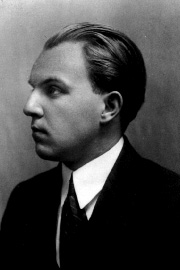
Composers
- A Concert of Music by Ernst Krenek: In honor of his 80th birthday (April 18, 1980)
- A recording of a concert given in celebration of Ernst Krenek's 80th birthday, on April 18, 1980 at the San Francisco Museum of Modern Art, and sponsored by the Goethe Institute. Charles Boone, who studied with Krenek, introduced the composer who then introduced the program of a number of his early compositions.
- Arnold Schoenberg Statement by Ernst Krenek
- Composer Ernst Krenek (1900-1991), pupil of the Austrian composer Arnold Schoenberg (1874-1951), is talking about his teacher.
- Ernst Krenek talks about "Johnny spielt auf"
- Krenek: "Wanderlied im Herbst" (Op 71 No 1)- Glenn Gould and Patricia Rideout
- Glenn Gould and Patricia Rideout play Ernst Krenek's "Wanderlied im Herbst" from the Gesänge des späten Jahres.
- Krenek: "Wanderlied im Herbst" (Op 71 No 1)
- Glenn Gould and Patricia Rideout play Ernst Krenek's "Wanderlied im Herbst", from the Gesänge des späten Jahres.
- Krenek: #1- Robert Donnelly
- Krenek: Jonny spielt auf - So hier bin ich
- Jonny spielt auf (Krenek). Duet 2 Act/ Ivonne: Patricia Gonzalez - Jonny: Luciano Garay. Cond: Stefan Lano-
Teatro Colon.
- Krenek: Lamentatio Jeremiæ Prophetæ, Op. 93 [1/9]
- RIAS Kammerchor / Marcus Creed / Harmonia Mundi (1995, 2008)
The Lamentatio Jeremiae Prophetae for chorus, Op. 93, by Austrian American composer Ernst Krenek is, on the one hand, one of the most austere and severe works composed in the twentieth century, and on the other hand, one of the most emotionally and spiritually moving works of the twentieth century. Written in November 1941 when Krenek was living in exile in the United States, having left his beloved Austria after the rise of the National Socialists, Krenek's Lamentatio Jeremiae Prophetae (Lamentations of the Prophet Jeremiae) is a elegy for his lost homeland couched in the language of the Biblical prophet's lament for the fall of Jerusalem. Krenek had been studying the music of Ockeghem, and his Lamentatio is steeped in the linear counterpoint and floating rhythm of the late medieval period. At the same time, however, Krenek's harmonic language was suffused with the serial method of Schoenberg and the combination of the influences of Ockeghem and Schoenberg can be heard in every bar of the work. Setting texts he chose himself from the Book of Jeremiah, Krenek's a cappella work is arranged in three large sections that are subdivided into smaller subsections. The choral writing ranges from monody to 20 separate parts, but it is nevertheless always clear and lucid. [Allmusic.com]
- Krenek: Lamentatio Jeremiæ Prophetæ, Op. 93 [2/9]
- RIAS Kammerchor / Marcus Creed / Harmonia Mundi (1995, 2008)
- Krenek: Lamentatio Jeremiæ Prophetæ, Op. 93 [3/9]
- RIAS Kammerchor / Marcus Creed / Harmonia Mundi (1995, 2008)
- Krenek: Lamentatio Jeremiæ Prophetæ, Op. 93 [4/9]
- RIAS Kammerchor / Marcus Creed / Harmonia Mundi (1995, 2008)
- Krenek: Lamentatio Jeremiæ Prophetæ, Op. 93 [5/9]
- RIAS Kammerchor / Marcus Creed / Harmonia Mundi (1995, 2008)
- Krenek: Lamentatio Jeremiæ Prophetæ, Op. 93 [6/9]
- RIAS Kammerchor / Marcus Creed / Harmonia Mundi (1995, 2008)
- Krenek: Lamentatio Jeremiæ Prophetæ, Op. 93 [7/9]
- RIAS Kammerchor / Marcus Creed / Harmonia Mundi (1995, 2008)
- Krenek: Lamentatio Jeremiæ Prophetæ, Op. 93 [8/9]
- RIAS Kammerchor / Marcus Creed / Harmonia Mundi (1995, 2008)
- Krenek: Lamentatio Jeremiæ Prophetæ, Op. 93 [9/9]
- RIAS Kammerchor / Marcus Creed / Harmonia Mundi (1995, 2008)
- Krenek: Sinfonia No.1, Op.7 (1921)
- Movements: 1st & 2nd.
- Krenek: Sonata for Piano Nr. 7, Op. 240 PART 1
- Wolfgang Schorn, Klavier
(18.12.1992, Düsseldorf)
- Krenek: Sonata for Piano Nr. 7, Op. 240 PART 2

- Wolfgang Schorn, Klavier
(18.12.1992, Düsseldorf)
- Krenek: Three Merry Marches
- Krenek: Violin Concert No.1 Op.29